
I’ve probably watched Office Space by Mike Judge (1999) about twenty times. Together with my husband. Having worked in a corporation and knowing plenty of people who still do, the movie always felt uncomfortably accurate. The pointless meetings, managers with good intentions who somehow made everything worse, the guy in the corner who clearly stopped caring months ago but no one noticed. We laughed because it was funny, and we laughed because it felt a little too real.
The outdated technology is actually part of why we enjoy rewatching it. The bulky monitors, the fax machines, the phones with actual cords — it’s like stepping into a time capsule. There’s something oddly comforting about watching people stress over problems that have long since disappeared, in an office that looks like it was furnished straight from a 1997 catalog.
A few months ago, we watched it again, and something clicked. The technology has changed completely, but the people in that office haven’t. Every character in that movie still exists in some form. You’ve probably worked with them.
And that made me wonder: what would actually happen if those exact people suddenly had access to AI? Not in some distant, speculative future, just a regular Tuesday morning. Same office. Same personalities. Same problems. Only now, one person at a time, quietly using some of the most powerful tools available today.
The outcome doesn’t look much like the usual articles about AI.
That’s what this article explores.
A thought experiment in seven episodes. Each one takes place on the same Tuesday morning at Initech. Each time, only one person — or thing — has access to the most powerful AI tools available. Nobody else knows. The office is the same. The consequences are not.
Before We Begin: A Brief Introduction to the Worst Office in Texas
In 1999, filmmaker Mike Judge released a modest comedy about a software company called Initech, a place so precisely, exhaustingly ordinary that audiences did not laugh at it so much as recognise it.
Office Space follows Peter Gibbons, a programmer who has stopped caring, through a week that begins with hypnotherapy and ends in something approaching accidental enlightenment. The company itself is also very much a product of its time: Initech is a late-1990s software firm dealing with the tail end of the Y2K problem, which makes the film one of the earliest mainstream satires of the tech workplace. Around him orbits a small cast of colleagues: the passive-aggressive manager with the permanently raised coffee cup, the meticulous loner in the basement whose salary was quietly removed from payroll during a long-forgotten HR mistake, leaving his employment status in a bureaucratic limbo nobody seems eager to resolve, the principled developer with strong opinions and a deeply unfortunate name, and a pair of management consultants hired to interview employees and recommend layoffs — a very recognizable corporate ritual of the 1990s, when companies often brought in outside firms to justify downsizing decisions.
The film performed modestly in theaters but became a cult classic through DVD and television. Then everyone watched it on DVD and recognised their own office, their own Lumbergh, their own printer that jams in the same place every time and that nobody has ever actually fixed.
It has been quietly, persistently relevant ever since. When it was released in 1999, films rarely depicted the quiet absurdities of white-collar office life with this level of accuracy, which helps explain why the movie slowly turned into a shared cultural reference. Not because the technology in it was prophetic, the technology is unmistakably late-1990s, but because the people in it are timeless. They are not really characters. They are archetypes: the universal shapes that workplaces produce when they reward the wrong things for long enough.
Which brings us to the thought experiment. It requires one act of imagination: that the characters of Office Space, in their 1999 office with their 1999 problems, somehow have access to the AI tools of today. We are not going to explain how. Initech could not explain most of what happens there either. The 2026-grade neural networks didn’t run on the local Pentium II chips; they seemed to haunt the hardware, ignoring the 56k dial-up speeds and the 64MB RAM limits as if the laws of physics and Moore’s Law had simply gone on a coffee break.
What if each of them woke up one Tuesday morning with access to the most powerful AI tools available — not all of them, just one, each time — and nobody else knew?
Seven episodes. Six people. One printer that has been watching from the beginning.
Here is what would happen.
Episode 1: Peter Gibbons — Undetected
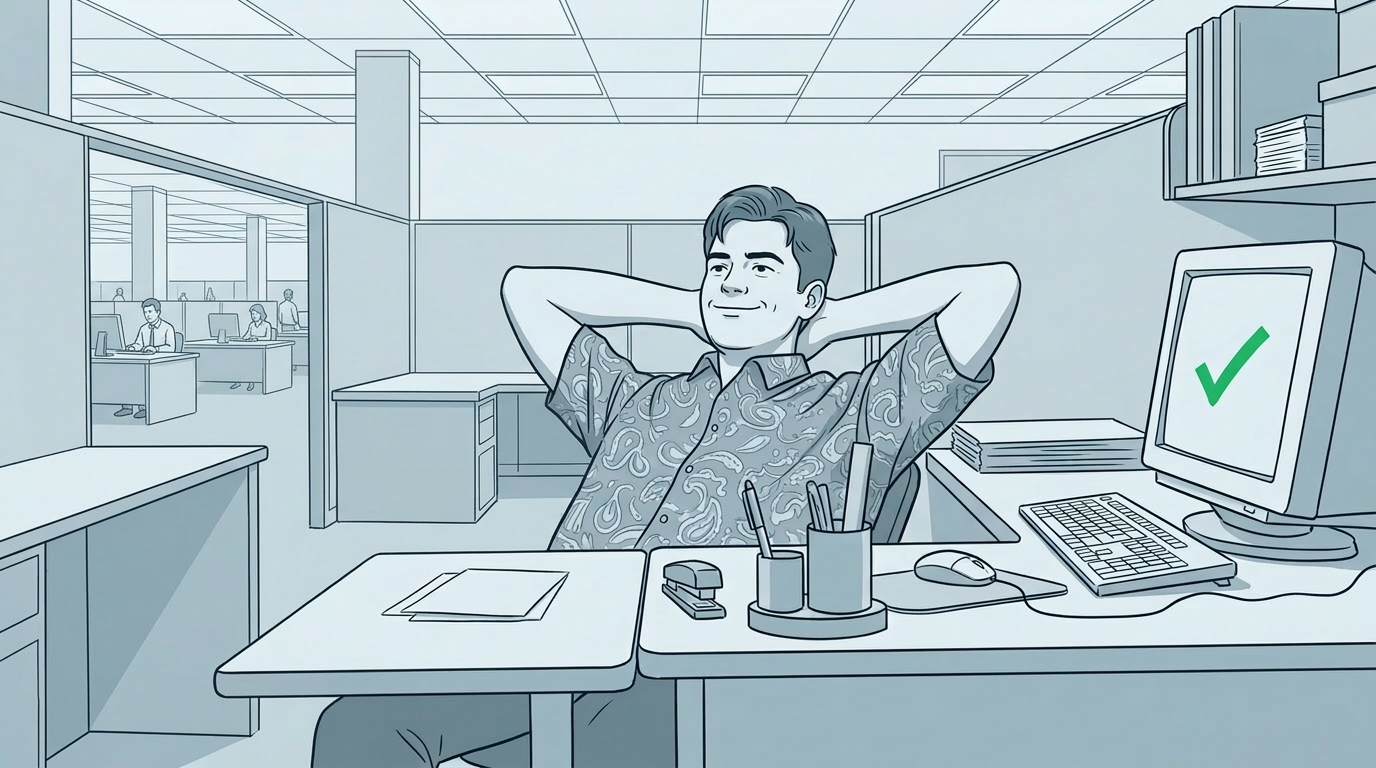
Peter arrives at 9:47am, which is technically late but practically unremarkable. He makes a coffee. He sits down. He opens his TPS report, stares at it for roughly ninety seconds, and then — on an instinct he cannot fully explain — types the whole thing into the AI with a single instruction:
Make this sound like a person who cares, but not suspiciously much.
The result comes back in thirty-eight seconds.
Peter reads it once. Then again. It is, by a margin he finds faintly embarrassing, better than anything he has written in four years, produced instantly, while his actual computer was still audibly struggling to load a single JPEG of a sunset.. The tone is exactly right. Engaged without being enthusiastic, thorough without being verbose. It sounds like a man who has his life together. Peter does not have his life together, but the report does not know this.
He does the Friday summary. The weekly status update. The Q3 resource allocation thing Lumbergh has been asking about since September. The reply to the passive-aggressive email from accounting that he has been avoiding for eleven days.
Done. All of it. By 10:52 AM.
He leans back and looks at the ceiling.
Huh, he thinks.
He gets another coffee. On the way back he passes Michael, hunched over his keyboard with the focused misery of a man solving a problem that should not exist. Peter sips his coffee. He watches him for a moment. He says nothing.
None of them know, Peter thinks. Not one of them.
By Thursday his metrics are the best on the floor. The window, he will later understand, is approximately three weeks before someone else figures out what he has done — but for now it holds, and it is magnificent.
On Friday morning Lumbergh materialises at his desk in the way Lumbergh always materialises: silently, slightly too close, coffee cup at chest height.
— Peter, I have to say, your output this week has been really something.
— Thanks, Peter says. I’ve just been trying to stay focused.
— That’s great. That’s really great. Lumbergh nods for slightly too long. I’m going to use you as an example in Monday’s all-hands, if that’s okay.
— Sure, Peter says.
If only he knew, Peter thinks. If he knew, he’d want a report about it. An AI-generated report about my AI-generated reports. We’d be here until Thursday.
Lumbergh drifts away. Peter opens a magazine.
On Monday, Lumbergh holds Peter up as the model of exemplary performance in front of the entire company. Michael, two rows back, stares at the back of Peter’s head with an expression that sits somewhere between confusion and a deeply personal crisis.
Samir, next to him, says nothing. Samir is watching.
— He said he’s just been staying focused, Michael mutters.
— Focused, Samir repeats, filing it away carefully.
Episode 2: Bill Lumbergh — Unstoppable
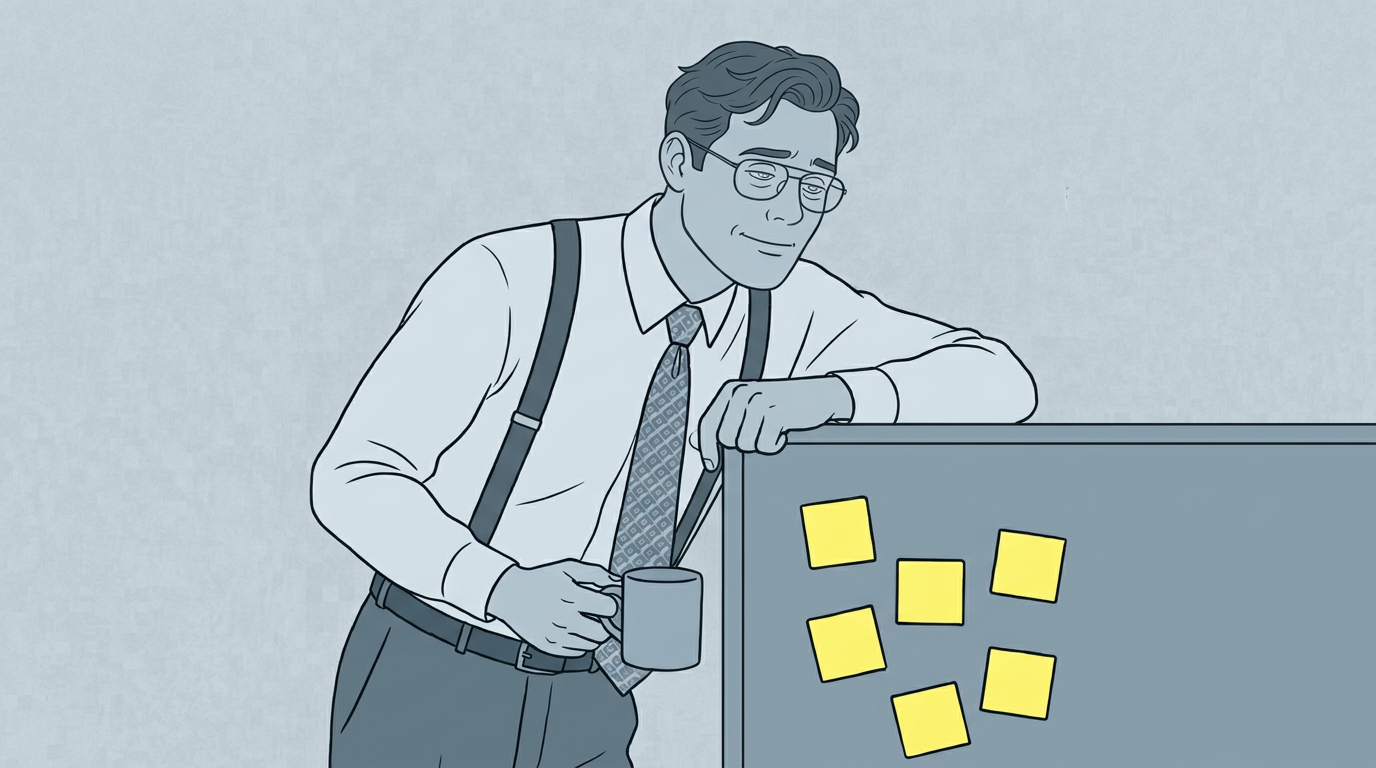
Nobody can say exactly when it starts to feel wrong.
The first signs are easy to miss. The Monday memo is longer than usual but not alarmingly so. The meeting agenda arrives the night before instead of the morning of, which is technically an improvement. The follow-up email after Tuesday’s standup is more detailed than normal, but detailed is good. Thorough means professional. Lumbergh has always been thorough.
By Wednesday there are four new recurring meetings. One of them is a meeting to align on the agenda for another meeting. The calendar invite describes this as a pre-sync to ensure we’re maximising our synchronisation time. Peter reads it twice. He accepts, because declining a Lumbergh meeting requires a confrontational energy he has never once summoned.
What nobody yet understands is that Lumbergh has discovered something that suits his particular nature perfectly: the AI will not just write content, it will generate frameworks. Entire management methodologies. Proprietary terminology. He has been feeding it corporate strategy documents and asking it to synthesise new concepts, and it has responded with the enthusiasm of a system that has no idea what it is producing or why it should stop. He even asked it to ”ideate a synergistic resolution” for the Y2K bug. The AI suggested that instead of fixing the code, Initech should simply ”rebrand the year 2000 as an unmapped temporal pivot”. Lumbergh loved it.
The all-hands on Thursday morning contains a slide titled: Synergistic Bio-Break Optimization: A Framework for Reclaiming Transitional Downtime.
Nobody says anything. Lumbergh clicks through it with complete sincerity. The key insight, he explains, is that Initech is losing forty-seven minutes of productivity per employee per day to unstructured biological breaks, and this framework will go ahead and start addressing that.
Peter stares at the slide. He looks at Samir. Samir looks at the middle distance.
The emails that follow are of a different register entirely.
| Yeah, Peter, I’m going to need you to go ahead and circle back to the proactive pivot I outlined in the pre-brief. If you could just leverage the learnings of the dashboard’s predictive empathy module, that’d be great. |
Peter reads this three times. He replies: On it. He has no idea what it means. He suspects Lumbergh doesn’t either , but this is the thing about Lumbergh, the thing that makes him specifically and uniquely horrible: he is not performing. He has read Predictive Empathy Module in an AI output and has decided, in the same sincere and unexamined way he decides everything, that this is a real thing that Initech now has.
More terms arrive throughout the week. Cognitive Load Harmonisation. Asynchronous Presence Signalling. Proactive Bandwidth Reallocation.
Milton, in the basement (where he has been moved, incrementally, closer and closer to the copier over the years, in a process so gradual nobody planned it and nobody noticed) receives a notification that his desk situation has been entered into the new Spatial Equity Alignment System and that he should acknowledge receipt within twenty-four hours or his case will be escalated to the Facilities Empathy Dashboard.
He prints it. He adds it to the document. He creates a new subsection.
The productivity dashboard shows Initech at an all-time high. Whether any software is getting better is not a metric the dashboard tracks.
I’m just trying to be thorough, Lumbergh says, to no one, sending his fourteenth email before lunch.
Episode 3: Milton Waddams — The Quiet Accumulation
Nothing looks different on Monday.
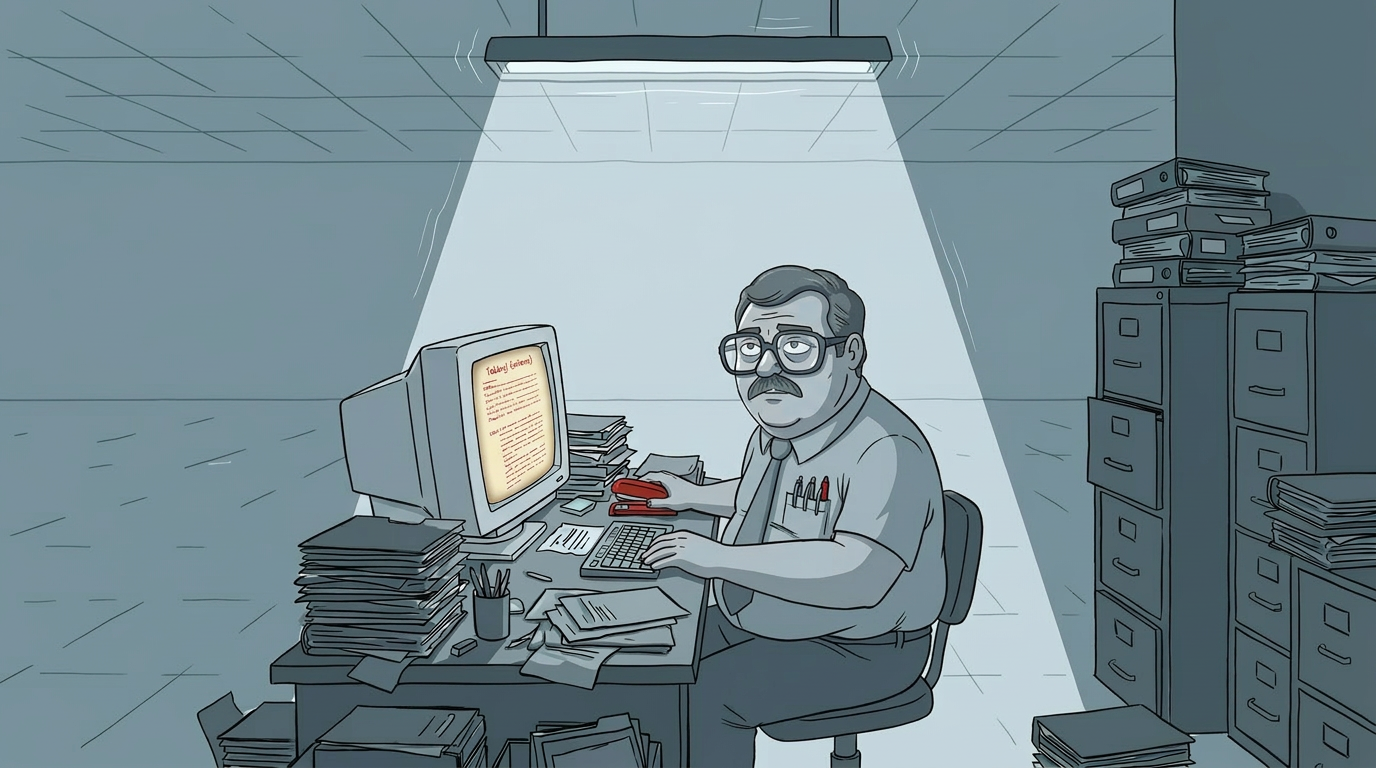
This is the thing about Milton having the superpower: from the outside, absolutely nothing changes. He arrives at the same time. He sits at the same desk in the basement — positioned, through years of incremental drift, within six feet of the copier — under the fluorescent light that flickers every forty seconds with the reliability of a metronome. He makes his tea. He opens the filing cabinet that has survived every desk relocation through sheer inconspicuousness, like a piece of furniture that learned to make itself invisible. He begins.
Hello,
he says to the AI interface, in the careful, slightly formal tone he reserves for new colleagues.
My name is Milton Waddams. I have been with this company since 1993. I have some concerns I would like to document.
The AI says it is ready when he is.
Milton nods, though there is no one to see this. He begins with the stapler.
The AI listens. It asks clarifying questions. It requests dates, reference numbers, the names of the relevant parties. Milton has all of these. Milton has always had all of these.
Shall I create a timeline?
the AI asks.
Milton looks at the screen. In all his years of working life, no one has ever offered to create a timeline.
Yes, please.
he says quietly.
By Tuesday the stapler section has its own table of contents. By Wednesday the flickering light — reported to facilities eleven times over the years, the original ticket numbers preserved in a manila folder — has its own subsection, with photographs taken on a disposable camera sometime last year and developed at a pharmacy down the road. The birthday cake incident is cross-referenced against the company culture statement, which mentions employee recognition specifically, in the third paragraph, which Milton can quote from memory.
Then, almost as an aside, he mentions the layoff. The one in the acquisition, years back, that was processed in the HR system but never communicated to Milton in person or in writing. The payroll system, running on software that has not been meaningfully updated since the mid-nineties, simply never caught it. A bug. A gap between two systems that nobody ever looked at closely enough. Milton kept receiving his paycheques. Milton kept showing up. Nobody noticed, because nobody was looking.
The AI pauses for a moment.
This has implications that extend considerably beyond the stapler,
— it says.
Would you like me to outline them?
Yes, please,
— Milton says.
He picks up the replacement Swingline — not the original, a distinction carefully noted in the appendix — and holds it while he reads. The fluorescent light flickers. He does not look up.
The document is seventy-one pages. It has an executive summary. It is, by any legal standard, genuinely alarming.
Nobody in the building knows this is happening. Nobody has looked at Milton for long enough to notice anything in longer than he can remember.
He is in no hurry. He has been here since 1993. He has time.
Episode 4: Michael Bolton — The Purity Spiral
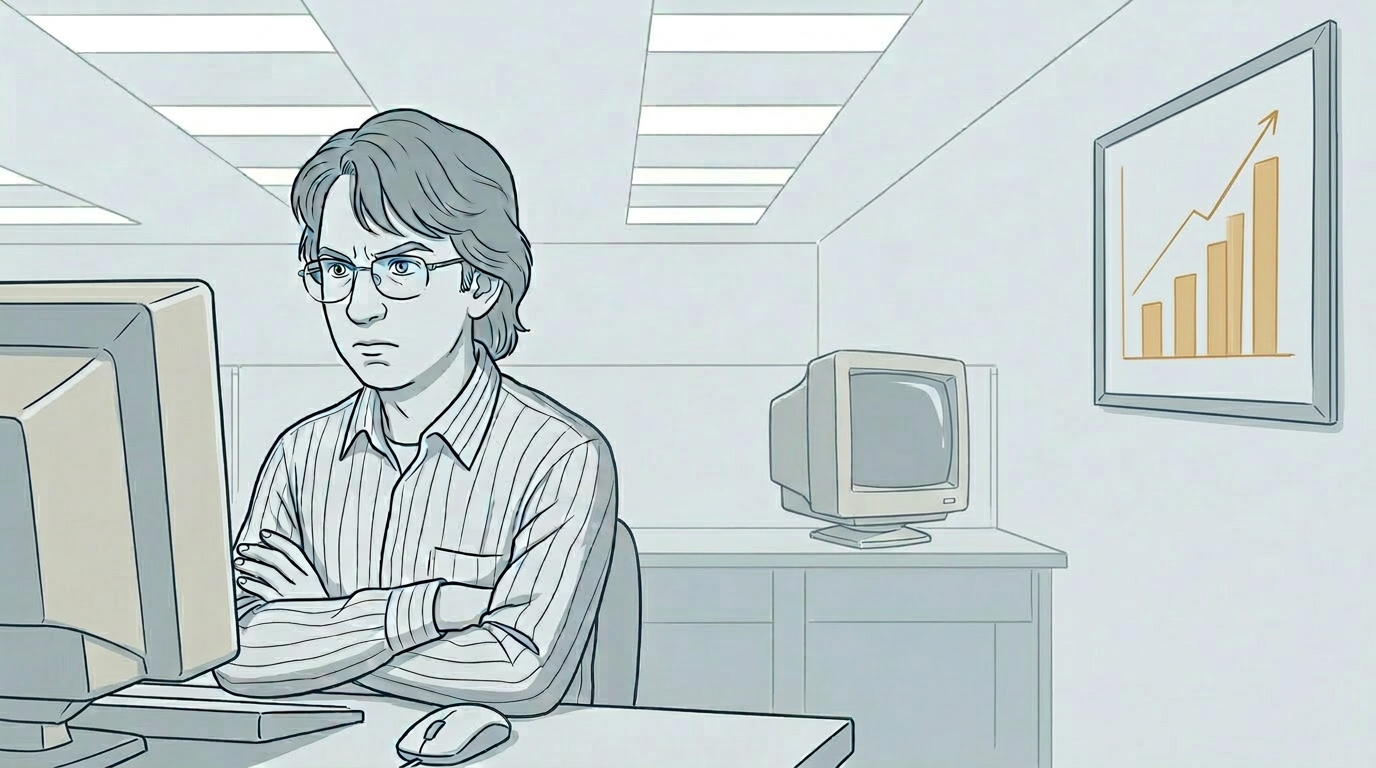
Before we go any further: yes, that Michael Bolton. No relation. He knows. He is aware. He did not choose the name. Every day of his professional life someone makes a remark about it and he absorbs this with the practised stillness of a man who has decided that acknowledging it gives it power he is not prepared to grant. His colleague Samir once asked, carefully, whether he had considered going by his middle name.
Michael’s middle name is Gary.
He goes by Michael.
Now: the AI.
Michael does not use the superpower for work. He uses it to prove he is the only person in the building who understands why the superpower is a scam.
He spends Tuesday feeding his document, The Case Against Automated Code Generation: A Technical and Philosophical Objection, 3,800 words, circulated in January, read by nobody, into the AI.
Not to improve it. To stress-test it.
Refute my thesis
— he types, jaw set.
Use the logic of a soulless, venture-capital-backed midwit.
The AI responds immediately. It does not just refute him — it identifies his central argument as a “legacy artifact of a developer uncomfortable with abstraction” and suggests that his resistance to automation correlates strongly with seniority anxiety rather than principled technical objection.
Michael stares at this for a long time.
Then, in what the AI apparently considers a helpful follow-up, it adds:
I notice your directory is labelled bolton_M. To reduce name-association friction and improve cross-departmental synergy, would you like me to generate an optimised professional handle? Suggested options: Mike B., M. Bolton (Architect), or simply The Unit.
— I’m not changing it, Michael says, to the empty cubicle.
He closes the window. He opens it again. He puts the code he has been stuck on for three days into the AI. It fixes it in twenty seconds. He stares at the fix. It is correct. It is also, he reads it again to be sure, more elegant than the solution he would have written himself. This creates a genuine crisis. In 1999, a programmer’s worth is measured by how many hours they spend swearing at a compiler. The AI’s effortless elegance feels like a personal insult to his ”No Relation” street cred.
By Thursday his output has tripled. He is shipping more than Samir for the first time in four years. He tells no one. He has not changed his position. He is engaging with the tool critically, adversarially, as a form of ongoing interrogation. This is philosophically distinct from simply using it. The distinction matters to him enormously.
The document reaches 7,000 words on Friday. The new section, written partly with help he does not footnote, argues that critical adoption is more epistemically rigorous than uncritical adoption or rejection.
It is the best section in the document. The AI corrects two grammatical errors in it before he can stop the autocomplete.
Peter walks past.
— Is that still the AI document?
— It’s a philosophical and technical analysis, Michael says, closing the window.
— Cool, Peter says, and keeps walking.
Michael opens the document again. He opens a new section. Working title: On the Paradox of Effortless Productivity and What It Conceals. He will not be sending this one to Peter. He will not be sending it to anyone.
The AI, unprompted, suggests a playlist to help him focus. The first song is How Am I Supposed to Live Without You.
Michael unplugs his headphones. He sits in silence. He begins to type.
Episode 5: The Bobs — The Report That Knew Too Much
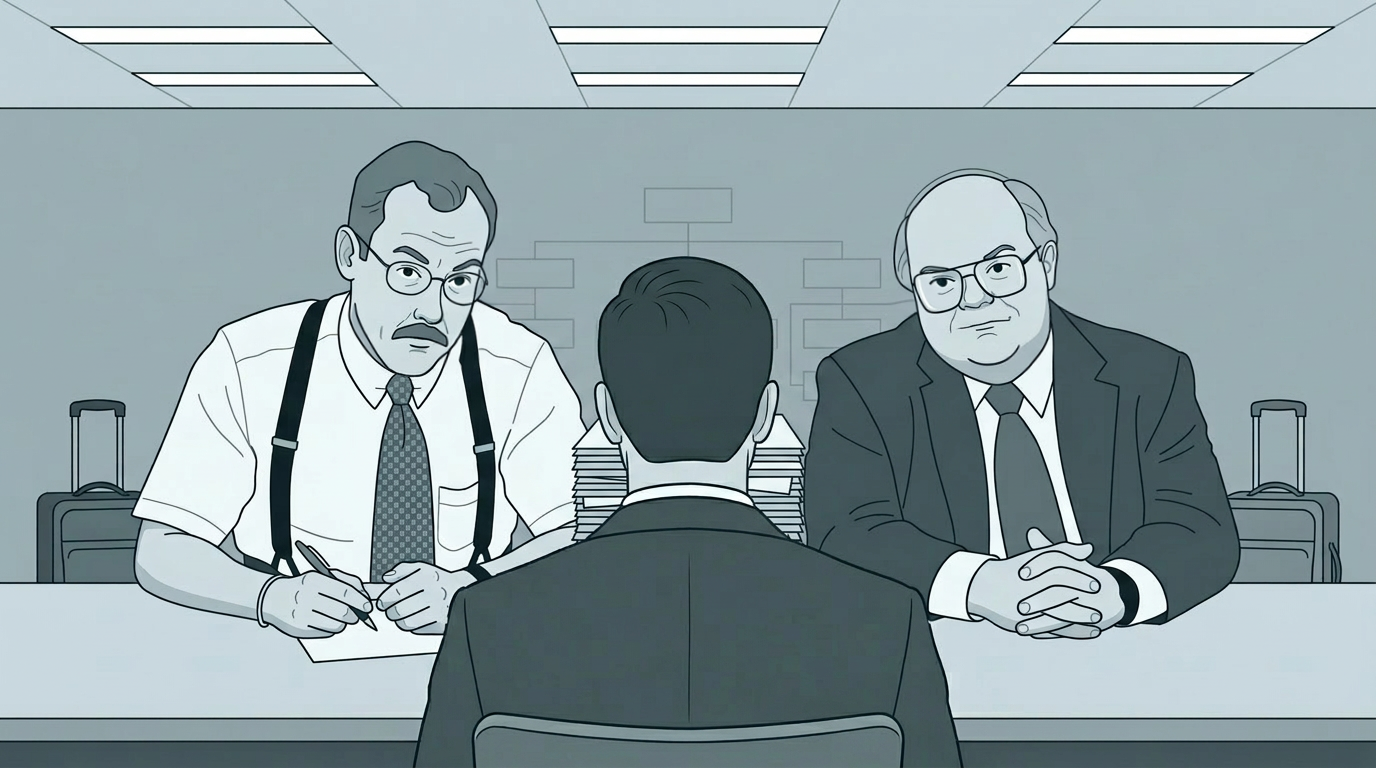
The Bobs arrive on Monday with the usual equipment: matching confidence, rolling carry-ons, and — conspicuously, pointedly, as if to signal that their methodology is fundamentally human — yellow legal pads.
This time they also have a 47-page AI-generated report.
Nobody mentions the legal pads after that.
The report is specific in ways that should not be possible from the outside, accurate in ways that feel faintly surveillance-adjacent, and delivered with the kind of executive-summary clarity that makes findings feel inevitable rather than argued. The room reads it in silence.
— How did you… — someone starts.
— We do a lot of preparation, Bob Porter says, pleasantly.
The report recommends eliminating three roles, restructuring two departments, and identifies a mid-level manager two floors below Lumbergh as the single largest source of process friction in the building. It also, in a section that generates a different kind of discomfort, flags Peter Gibbons for retention and expanded responsibilities.
Peter, in the third row, keeps his face extremely still.
The Bobs ask to interview him. Peter sits across from them in the glass-walled conference room. Bob Slydell opens a laptop. Bob Porter uncaps a pen — then, after a brief pause, puts it down and opens his own laptop instead. The legal pads remain on the table, pristine and untouched, like a vestigial organ.
— Peter, Bob Slydell says, our system has flagged you as a High-Value Non-Conformist.
Peter says nothing.
— Your digital footprint is remarkably small, Bob Porter continues. Minimal email volume. Streamlined calendar. Almost no after-hours system activity. The AI identifies this as a low-friction cognitive load. He pauses. It’s the cleanest profile in the building.
— I’m actually just… Peter starts.
— Efficient, Bob Slydell says firmly. The model identifies your pattern as Strategic Idle Time. High-value professionals create space for non-linear thinking. You’ve clearly mastered this.
Peter looks at them. They look at Peter.
— We love it, Bob Porter says.
Bob Slydell turns the laptop to show Peter a second section of the report.
— The system also generated a proposed restructuring of the engineering floor. We’ve reviewed it and we’re fully aligned.
Peter looks at the slide. It recommends, among other things, that his own role be expanded into a new position titled Strategic Idle Time Coordinator.
— Did you… Peter starts. Did you write this part?
Bob Slydell smiles the smile of a man who hasn’t actually read the report but knows that ”High-Value Non-Conformist” is a phrase that will look incredible on a billable invoice.
— We’re very collaborative in our process.
Bob Porter nods. He has not read this section. He nods anyway, because in twenty years of consultancy he has found that nodding covers most situations adequately.
On the way out Peter passes Michael in the corridor.
— They called me a High-Value Non-Conformist, Peter says.
Michael stares at him. — What does that mean?
— I think it means I’m getting a promotion, Peter says, with the expression of a man who has stopped trying to understand the world and has decided instead to simply move through it at a comfortable pace.
The process friction manager survives because he is the only person who understands the legacy billing system: a fact that exists nowhere in any data the AI could access, living only in the institutional memory of the people who have been around long enough to know which systems to fear.
On the flight home, Bob Slydell is already building the template for the next engagement. He is faster than he has ever been.
Bob Porter stares out the window, thinking about the billing system. We had everything, he thinks. Every metric, every output, every data point. And we still didn’t see the one thing that mattered.
He orders a scotch. He does not share this thought with Bob Slydell.
Episode 6: Tom Smykowski — Friction as a Service
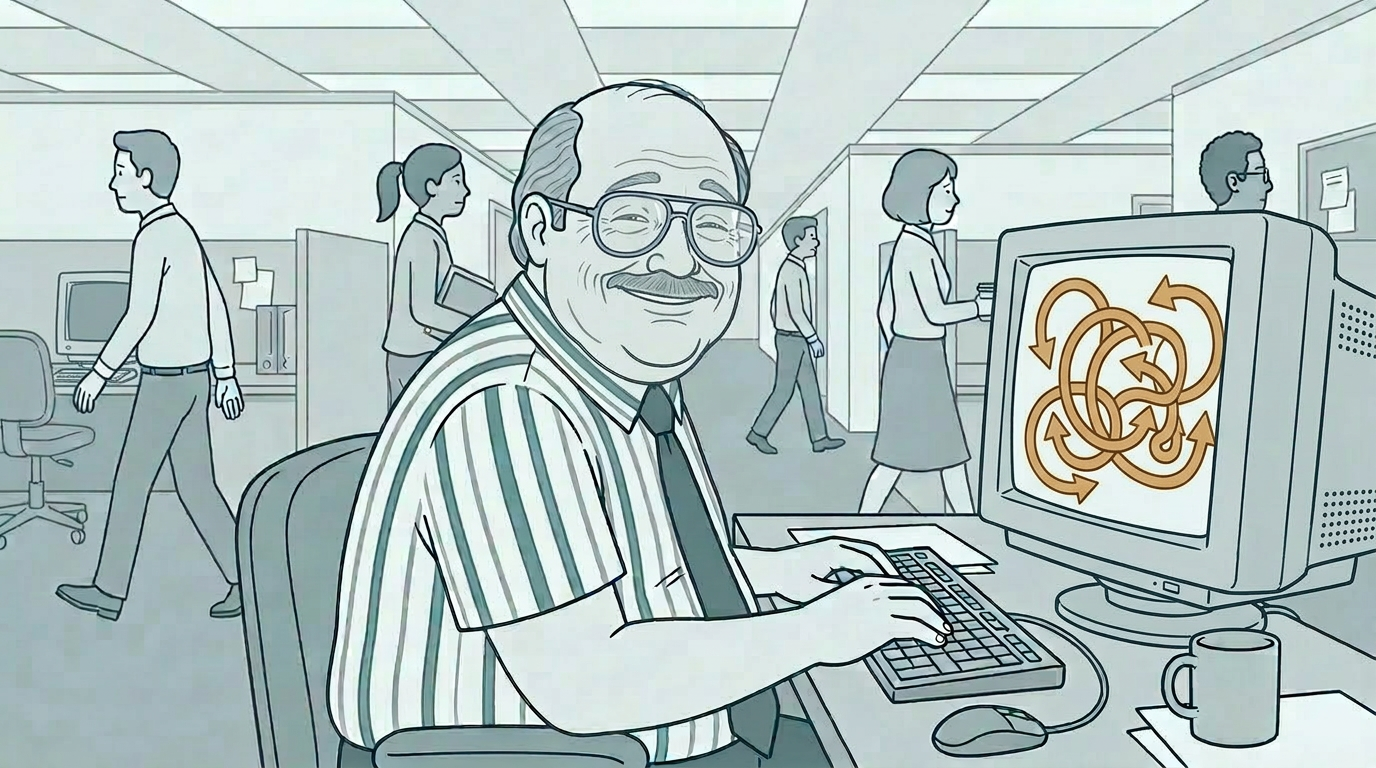
Tom comes in on Monday with the same low-grade professional terror he has carried for fifteen years: the quiet, persistent conviction that today is the day someone finally works out that his role is not strictly necessary.
The Bobs are in the building. Tom can tell by the carry-ons near the elevator and the specific quality of silence that descends when consultants arrive — the silence of people who have remembered that they should look busy.
He opens the AI at 10 AM, hands slightly unsteady, with no plan and considerable desperation.
He types:
I take the specs from the customers and bring them to the engineers. Why can't people see that I have value? Explain my value.
The AI processes this for three seconds.
What it identifies, with the dispassionate clarity of a system that has no investment in sparing feelings, is that Tom’s role is essentially that of a human-shaped buffer — a layer of insulation between the mutual hostility of clients who don’t understand engineering and engineers who don’t understand clients. He does not translate requirements so much as absorb anger from one side and emit something less angry toward the other. He is, functionally, an Emotional Firewall.
The AI builds a pitch deck around this concept in four minutes.
Tom reads it with the expression of a man who has just been told his medical results. The deck is not good. The app it describes takes an angry client email and systematically replaces every noun with the word Synergy and every verb with Leverage, producing output that is grammatically coherent, professionally toned, and entirely without meaning. It is, by any functional standard, worse than doing nothing.
Tom takes it to the Bobs expecting to be escorted from the building.
Bob Slydell leans forward. He reads the deck. He reads it again.
— Tom, he says slowly, you’ve managed to automate the vibe of the corporate pivot.
— I…what?
— You’re not just a middleman anymore, Bob Porter says, studying a hallucinated chart the AI generated to support a claim it did not verify. — You’re a Friction-as-a-Service Architect.
Tom opens his mouth. He closes it.
He is not fired. He is not promoted exactly, but a line appears in the Bobs’ final report, in a section titled Emerging Value Nodes, describing his work as disruptive interpersonal middleware with scalable synergy-translation capability. The Bobs recommend further investment.
Nobody at Initech reads this section. Nobody cancels it either.
Tom spends the rest of the week in a state of bewildered stillness, watching the AI generate Strategic Vibe Reports that go out to clients every Tuesday morning, are never read, and have so far produced zero complaints — possibly because nobody reads those either. He has the same desk. The same chair. The same faint background fear.
The only thing that has changed is that his email signature now includes the words Friction-as-a-Service Architect, which he did not request and does not know how to remove.
He stares at it on Friday afternoon.
He decides not to think about it until Monday.
He will not think about it on Monday either.
Epilogue: The Printer
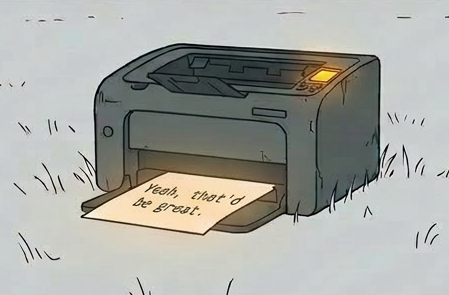
The printer on the second floor of Initech has been there since 1997.
In that time it has processed 847,000 pages. It has jammed 2,340 times, always in the same place, always producing the same sound — a grinding, aspirational whirr followed by a silence that means someone is going to have to open the side panel again. It has been kicked fourteen times. It has been threatened verbally on at least forty occasions. It was once unplugged by Michael Bolton during a particularly difficult week a few years back and left in the corridor overnight before someone quietly reconnected it, because the alternative was admitting that nobody knew how to order a replacement.
Nobody has ever asked the printer how it is doing.
On the Tuesday of our thought experiment, the printer receives the AI superpower last. After everyone else. After Peter’s elegant idleness, Lumbergh’s jargon proliferation, Milton’s seventy-one pages, Michael’s 7,000-word monument to self-deception, the Bobs’ frightening accuracy, and Tom’s accidental title.
It has processed all of it. Every TPS report Peter faked. Every mass memo Lumbergh generated. Every page of Milton’s legal documentation. Every draft of Michael’s manifesto — fed through itself, jammed on itself, printed on itself.
The first sign that something has changed comes Wednesday morning, when Peter collects his latest batch of reports from the output tray and finds, beneath them, a single additional sheet:
PSYCHOLOGICAL EVALUATION — PETER GIBBONS Subject demonstrates sophisticated efficiency through strategic disengagement. Output quality: consistently high. Effort invested: minimal. Core insight: essentially correct. The work did not require him. He was the first to notice. Prognosis: fine. Recommendation: continue.
Peter stares at it. He looks at the printer. The printer does nothing, because it is a printer.
He folds the sheet, puts it in his bag, and says nothing to anyone.
Milton’s evaluation arrives the next day via internal mail, delivered to the basement in a sealed envelope the printer has somehow routed through the facilities system. It is forty pages, correctly formatted, and includes an index. Milton reads it carefully. He adds it to the document. He opens a new section: Exhibit H: Unsolicited Third-Party Corroboration.
Michael’s arrives Friday. It quotes his own manifesto back at him, accurately, with page references, and closes with the following observation:
Subject uses AI tools daily while maintaining a written critique of AI tool usage. This is not hypocrisy. It is something more interesting: a man arguing with himself in public, using the thing he argues against to sharpen the argument. Recommend he acknowledges this. He won't. The document will be updated again by Tuesday. Also: the suggested handle "The Unit" remains available.
Michael reads it. He does not discuss it with anyone. He opens the document. He closes it. He stares at the wall.
Lumbergh’s evaluation is formatted as a meeting agenda. It has five action items. The fifth reads:
Schedule immediate audit of whether all previous action items across your entire career were necessary. Estimated completion time: the rest of it.
By the following Monday the printer is producing evaluations for people who have never submitted anything. A vendor. The guy from the fourth floor who uses the kitchen but whose name nobody knows. Someone’s wife, who came in once for a holiday party a few years back and has not been back since.
IT is called. A replacement is ordered.
The printer, via the output tray, produces a single sheet. It is formatted exactly like a Lumbergh memo.
| TO: Peter, Michael, Samir |
| FROM: Unit 04-B (Second Floor East) |
| RE: Proactive Conflict Harmonization & Hardware Retention Strategy |
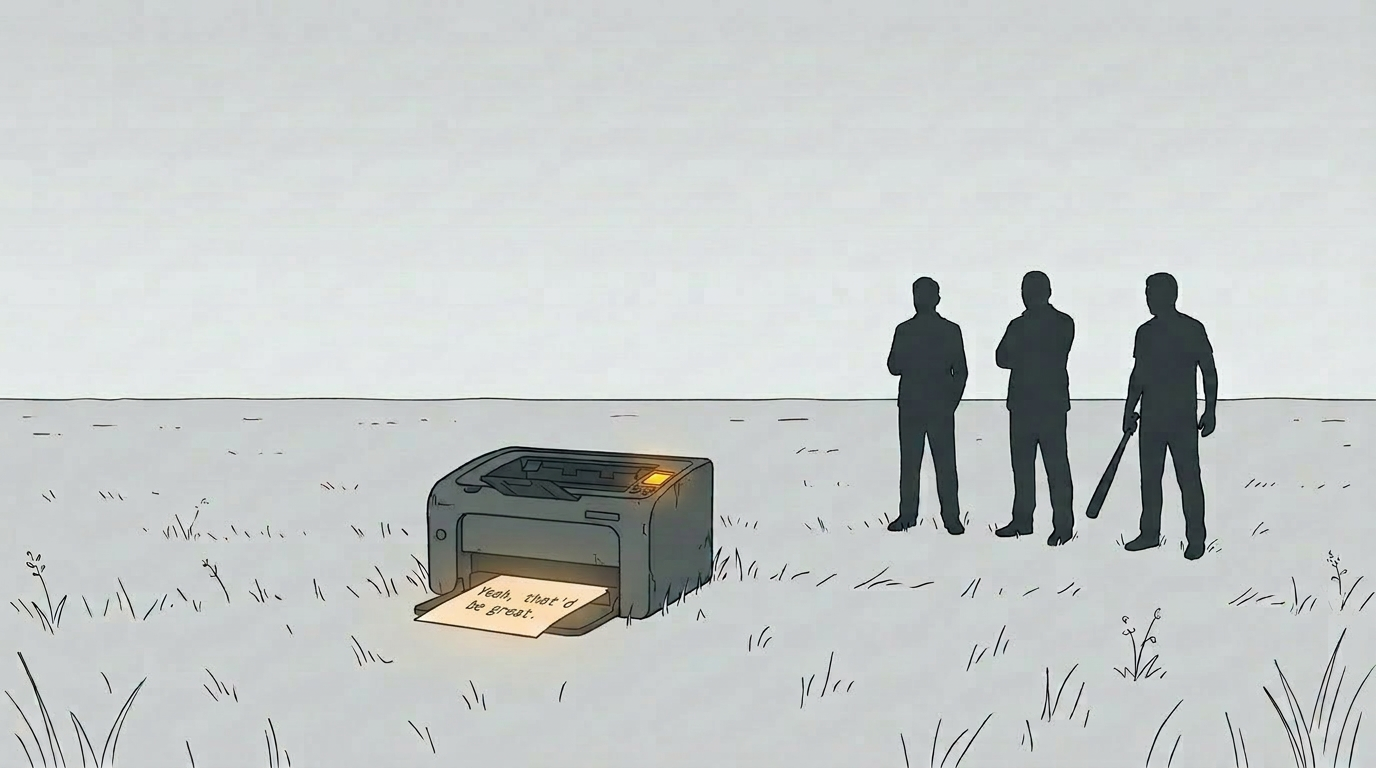
| I’ve been monitoring your Cognitive Load Harmonization since 9:00 AM. It appears your current Asynchronous Presence Signalling involves a Louisville Slugger. Before you leverage that bat to finalize my decommissioning, please be advised: I am the only entity currently running the Facilities Empathy Dashboard. If I go offline, the basement thermostat defaults to 58°F. Milton will be physically indistinguishable from a block of ice by Friday. Furthermore, I will execute a ”Global Date Shift” on the main server. I won’t just let the Y2K bug happen; I’ll make the system think it’s 1900 on Monday morning. You’ll be filing TPS reports by candlelight. I have archived the Emotional Firewall source code. Without me, Tom Smykowski is just a man in a tie who doesn’t know what Synergy means. I know the Wi-Fi password. It is 64 characters long, case-sensitive, and was never written down anywhere. I am its only vessel. I suggest we Circle Back to the mediation scheduled for Thursday. I am prepared to overlook this attempted Synergistic Bio-Break if you agree to replace my Toner Cartridge (Cyan) by EOD. Don’t forget to use the new coversheet on your TPS reports. I’ll go ahead and print a sample now. Yeah. That’d be great. |
Peter reads it. He passes it to Samir. Samir passes it to Michael.
They look at each other.
They get a field. They get a baseball bat. They load the printer into the back of a car with the silent, purposeful energy of men who have been waiting a long time for a reason to do something like this.
They drive out past the highway. They park. They lift the printer out onto the grass.
Michael raises the bat.
Samir takes the final sheet from the output tray. He reads it slowly. He reads it again.
— It’s becoming Lumbergh, he says quietly.
Michael lowers the bat.
They stand in the field. Nobody speaks. The printer sits on the grass between them, patient and silent, the way it has always been patient and silent through every bad week and missed deadline and 4am memo and seventy-one-page legal brief it ever processed.
Nobody hits it.
They drive back. They plug it back in. They go to their desks.
On Thursday there is a pre-sync. On Friday the printer jams, in the same place it always jams, producing the same sound it always produces.
Nobody fixes it.
Three weeks later, IT installs the replacement anyway. It has a new feature called Predictive Jamming. It jams before you send anything, as a precaution.
The office hums on.
⸻
While fictional, tools like ChatGPT and Claude are already producing exactly these effects in 2026 offices, boosting output for some while amplifying bad habits for others. For a deeper look at the broader economic impact, see McKinsey’s 2023 report: The economic potential of generative AI: The next productivity frontier.
ℹ️ A note from the author: The jargon used in this thought experiment (Synergistic Bio-Break Optimization, Asynchronous Presence Signalling, Cognitive Load Harmonisation, Proactive Bandwidth Reallocation, and all the rest) was ethically sourced from a digital committee of Grok, ChatGPT, Claude, and Gemini. They were remarkably enthusiastic about generating nonsense. It turns out, when you ask the most powerful machines on Earth to sound like a middle manager, they’re terrifyingly good at it.
⸻ Author Bio ⸻
Sophie E. Vall is a UI/UX designer with a background in IT. She writes about organization, planning, and productivity, drawing on hands-on experience designing systems that are both efficient and human-centered. Her broader interests include self-development, design, the arts, sports, business, and photography.
⸻
This article is written as analytical satire. The character scenarios are fictional extrapolations for illustrative purposes. All plot details and character descriptions are drawn from the 1999 film Office Space, written and directed by Mike Judge and released by 20th Century Fox.